
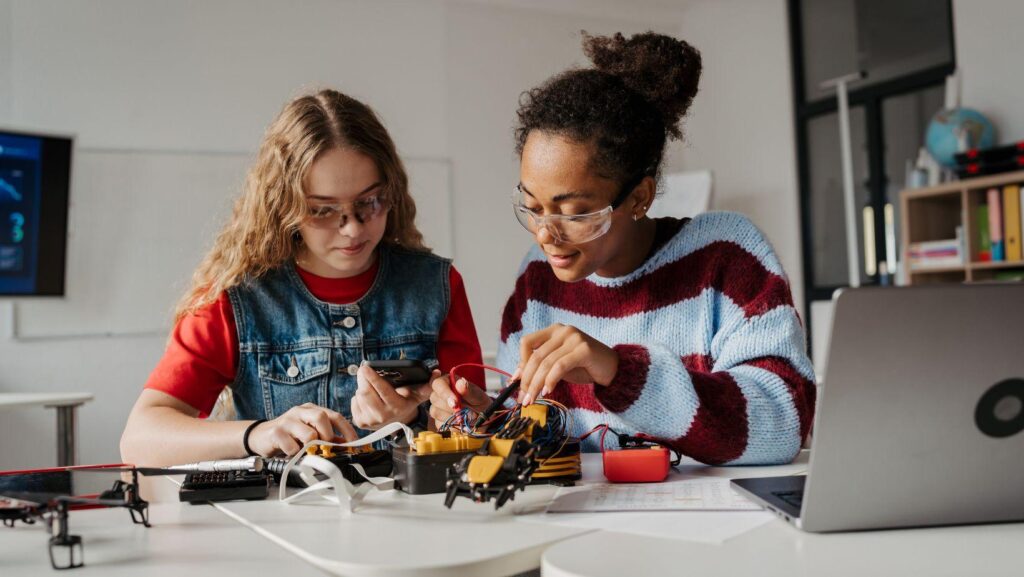
Walk into a STEM classroom built in the last few years and the shift is obvious. Robots sit next to microscopes. Headsets share shelf space with textbooks. Coding happens on laptops instead of worksheets. EdTech Magazine’s reporting on AR and VR adoption in K-12 schools captures this shift through real classrooms already living it, including a Chandler, Arizona teacher who had students build entire colonial-era settings and then step inside them with a headset, rather than the traditional diorama or poster board. None of this happened by accident, and none of it happened all at once. It’s the result of several distinct categories of technology maturing together, each solving a different piece of what STEM instruction actually needs, and a handful of companies working to bring all of it into classrooms coherently rather than piece by piece.
The Hardware Now Standard in STEM Classrooms
Robotics kits have moved from novelty to expectation. Giving students a physical object to program and troubleshoot tends to make abstract coding concepts click faster than a screen-only exercise ever could. 3D printing followed a similar path: once expensive and unreliable, printers are now common enough in STEM labs that students can move from a design sketch to a physical prototype within a single class period.
Augmented and virtual reality represent the newer end of this hardware category. These platforms let students explore things a standard classroom simply can’t offer physically, walking through a 3D model of human anatomy, manipulating a molecule, or running a physics simulation that would be impossible or dangerous to recreate in real life. This is a genuinely different kind of tool than a robotics kit or a printer: it’s not about building something physical, it’s about making the invisible visible.
What ties these hardware categories together is that none of them work well as one-off purchases. A single robotics kit or VR headset sitting unused in a closet because nobody had time to build a lesson around it is a familiar story in schools that moved fast on procurement and slower on planning. The tools that actually get used tend to arrive alongside curriculum content and teacher training, not as a standalone box.
Coding Platforms Built to Grow With Students
Coding instruction has also matured past a single one-size-fits-all approach. Younger students typically start with block-based coding, dragging visual pieces together to build logic without needing to type a single line of syntax. As comfort grows, many programs progress students toward text-based languages like Java and eventually Python, mirroring the actual progression a working software developer might have followed years earlier. Having a single platform or curriculum that spans this entire range, rather than switching tools and losing continuity every time a student moves up a grade level, has become a meaningful differentiator for schools building out a multi-year STEM program rather than a single unit.
Who’s Bringing These Technologies Into Schools
None of this technology reaches a classroom on its own. Districts generally work with an integrator or reseller who curates, bundles, and supports these tools, rather than buying directly from dozens of individual manufacturers and managing each relationship separately. A handful of names show up repeatedly in this space.
Bluum positions itself as a single point of contact across the full range of STEM categories, offering robotics, AR/VR, 3D printing, coding platforms, and learning environment solutions, working with school and district budgets of varying sizes rather than requiring a single large-scale commitment.
CDW Education operates at a broader scale across the education technology market generally, offering device ecosystems and strategic planning services alongside STEM-specific procurement, often for larger districts managing complex, multi-year technology refresh cycles.
Trafera focuses heavily on device lifecycle management and repair services alongside its STEM and classroom technology offerings, positioning itself around the full lifespan of a device rather than just the initial purchase.
Howard Technology Solutions has built a reputation specifically in K-12 hardware and classroom technology deployment, with a strong regional presence in parts of the Southeast.
Each of these companies solves the same basic problem, connecting schools with the technology categories described below, in a somewhat different way. The right fit tends to depend less on which name is most recognizable and more on which one’s specific strengths (device lifecycle support, regional presence, breadth of STEM categories covered) actually match what a given district needs most.
Why Learning Environment Design Is Becoming Its Own Technology Category
It’s easy to think of “STEM technology” as exclusively gadgets: robots, printers, headsets, laptops. But a growing body of research suggests the room itself, the furniture, the layout, the flexibility of the space, deserves to be treated as a technology decision in its own right, not an afterthought once the gadgets are chosen.
The most rigorous evidence for this comes from the HEAD Project (Holistic Evidence and Design), a multi-year study out of the University of Salford that tracked 3,766 primary school pupils across 153 classrooms. The peer-reviewed findings, published in Building and Environment and archived by the National Institutes of Health, found that differences in the physical characteristics of a classroom accounted for 16% of the variation in a pupil’s learning progress over a single year, a substantial effect when typical annual progress is measured in similarly modest increments. Flexibility of layout was one of the specific factors the study isolated as meaningful, not just lighting or air quality.
That research is exactly why furniture built specifically for STEM work, collaborative tables that reconfigure for group builds, mobile seating that supports quick transitions between lecture and hands-on project time, has started showing up as its own line item in school technology planning rather than something purchased separately from the “real” STEM budget. Learning environment planning built around this kind of flexibility is increasingly treated as part of the same strategic decision as the robotics kits and coding platforms sitting on top of the tables.
The Bottom Line
STEM education technology isn’t one thing anymore. It’s robotics and 3D printing solving the hands-on, build-something problem. It’s AR and VR solving the make-the-invisible-visible problem. It’s coding platforms solving the grow-with-the-student problem. And increasingly, it’s the room itself, treated as seriously as the gadgets inside it, solving a problem that research suggests schools have been underweighting for years. The districts getting the most out of their STEM investment tend to be the ones treating all of these as pieces of one coordinated decision, rather than a series of separate purchases made in isolation.